
14. THE DOCUMENTS AS OBJECTS
The documents tell stories, but they are also their own story.

14. THE DOCUMENTS AS OBJECTS
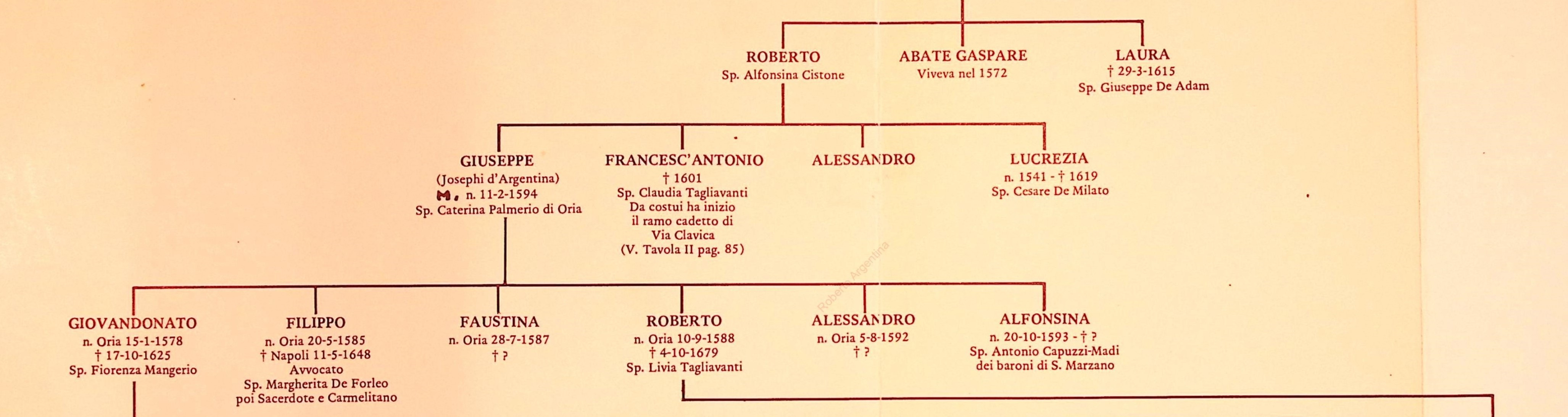
Giovandonato’s is the first generation about which exists an adequate supply of documents that can help to help create a story. About twenty of them, dated between 1600 and 1629, and they primarily concern themselves with the complex family relationship of Giovandonato’s wife, Fiorenza Mangerio, and her immediate family. The documents show a family living both in Naples and Francavilla and indicate an intricate web of inheritances, financial arrangements, as well as steady pecuniary support for institutions of the Church. There is a dual set of parallel interests that I consider while going through this archival content: there are, of course, the glimpses of a partial human story to be discovered through the fragments that remain in the record of letters and documents, and Giovandonato and Fiorenza’s will prove to be quite a story. On another level, I also find myself attracted to the documents themselves, the objects, and how they came to be and how they survived nearly five centuries. I have spent many hours working through transcriptions and translations trying to gleam meanings of what is going on – the story – but also being fascinated by the documents themselves, the calligraphy, the language, how were they written, why were they kept, how were they kept. Though I regret that I am only able to study the digital copies of the documents I scan every year when I visit Francavilla rather than the paper documents in the archive room, I also realize that if I had constant access to them, I would probably become fatally addicted to those old papers and going through them would absorb my entire life; I would spend entire days going through them like a crazy man, a junkie of old papers, because the artifacts themselves fascinate me just as much as the stories they tell. To touch those pieces of paper, sometimes parchment, on which someone put down their thoughts in ink so long ago gives me feelings of awe and an unsatisfiable yearning to want to know more.
In this essay I found myself giving the leading role to the documents themselves, they are after all the reason I started this project to begin with and they are what keeps me going back to Francavilla every year. Each document is a unique specimen with its own personality, a manifestation of the singular individual who wrote it by hand during a time prior to when mechanization took over such tasks. Just like people, some of the documents are easy to read, some are harder, and quite a few are, to me anyway, barely legible.


Left - 2/3/1629. Naples, inventory of the assets of Donato Antonio Mangerio, brother of Fiorenza, wife of Giovan Donato Argentina.
Right - 29/4/1617. Notarial deed of donation to the Monastery of the Rosary in Naples by Donato Antonio Mangerio, brother of Fiorenza, married to Giovan Donato Argentina.
Most of the documents are in incredible conditions for their age, but as can be seen by the two examples above, readability of these documents depends not only on the calligraphy, but also by other elements, such as ink bleeding through the other side of the paper.
One of my challenges after I trascribe the words is to understand the language in which they were written. Some of the papers are written in Latin, others are written in Vulgar Italian, some of them have a substantial number of Castilian Spanish words reflecting the administrative language of the Kingdom of Naples, and a few show a combination of those. The ones written in Latin have terms or words that show adaptations to a Latin that persevered in legal documents into the early modern era. The documents written in Vulgar Italian I find easy to comprehend as the language is not so distant from the Italian spoken today. Vulgar Italian, a language of the people, as opposed to religious and legal latin, spread through the peninsula through the works of Tuscan poets like Dante, Petrarca, and Boccaccio and was known by people with a certain level of education.
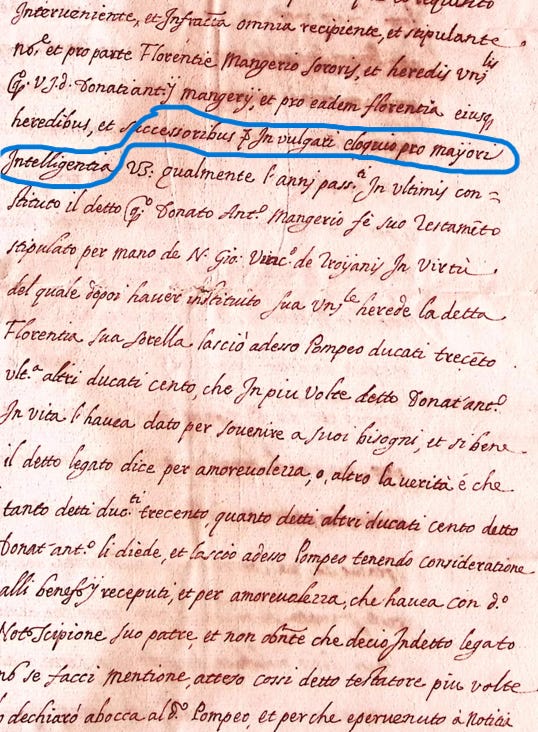
In the document above, the notary switches from Latin into Vulgar for a better comprehension by the client. It could be that this change was only for the client copy and not the original official act, and it also indicates that Latin, the language of the Church and the law was no longer completely familiar even to some educated people.
Perhaps it should not surprise that Vulgar Italian was widespread since it was the language of the Medici family, a business conglomerate with networks of banking institutions supporting trade that included wheat procured from the Terra d’Otranto. Even so, early Italian was probably limited to individuals of higher social standing and with some level of education, while most of the population in each community primarily spoke its own dialect, local and specific, which was and still is, distinct from towns that are only a few miles apart. On a final observation about the challenge of reading these documents besides their different languages, is that they also contain frequent uses of colloquialisms and honorifics or set phrases that are typical for the place and time and purpose, but are unknown to me, and it takes reading a few of them, or doing some research to understand what they mean.
Some documents were written in beautiful penmanship, while others were written in such a hurry that it seems the writer had much more important things to do at the time and just wanted to get it done. Additionally, in some of them there are abbreviations that made little sense to me, because they are just regular words, abbreviated to save just a few fractions of a second.
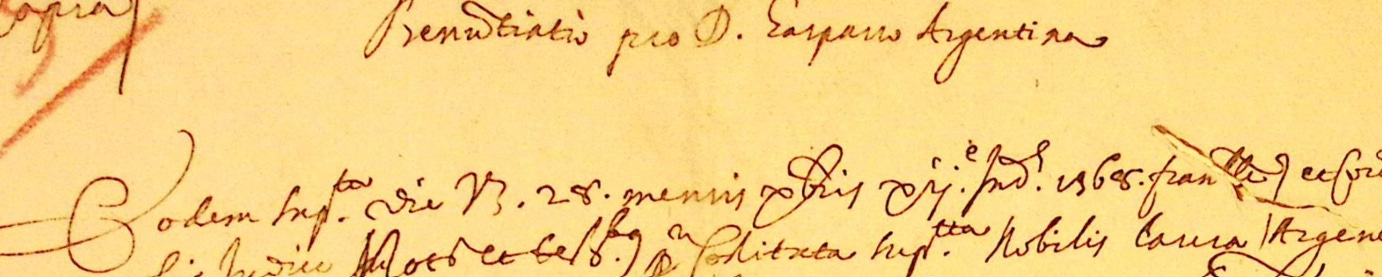
This first line from a document from 1568 (Laura Argentina’s story from essay #10) that shows the use of abbreviations. I had no idea what the first word ‘Godem’ meant until I researched that it was used as an abbreviation for; “On this day…”
I noticed that many of the documents have the word ‘copia’ written on the top left corner. For a while I thought that past relatives made copies of decaying documents, but upon reflection, it made little sense that someone would want to spend time with a document of minimal importance to them a couple of hundred years later, though, look at me now. Further, these ‘copied’ documents looked appropriately aged for their dates and comparable to others from the same period. I realized that these copies had not been reproduced later from older documents but were just as they were labeled, copies made at the time of the original document for the same purpose for which we print multiple copies of a document today, other people need copies of the doc.
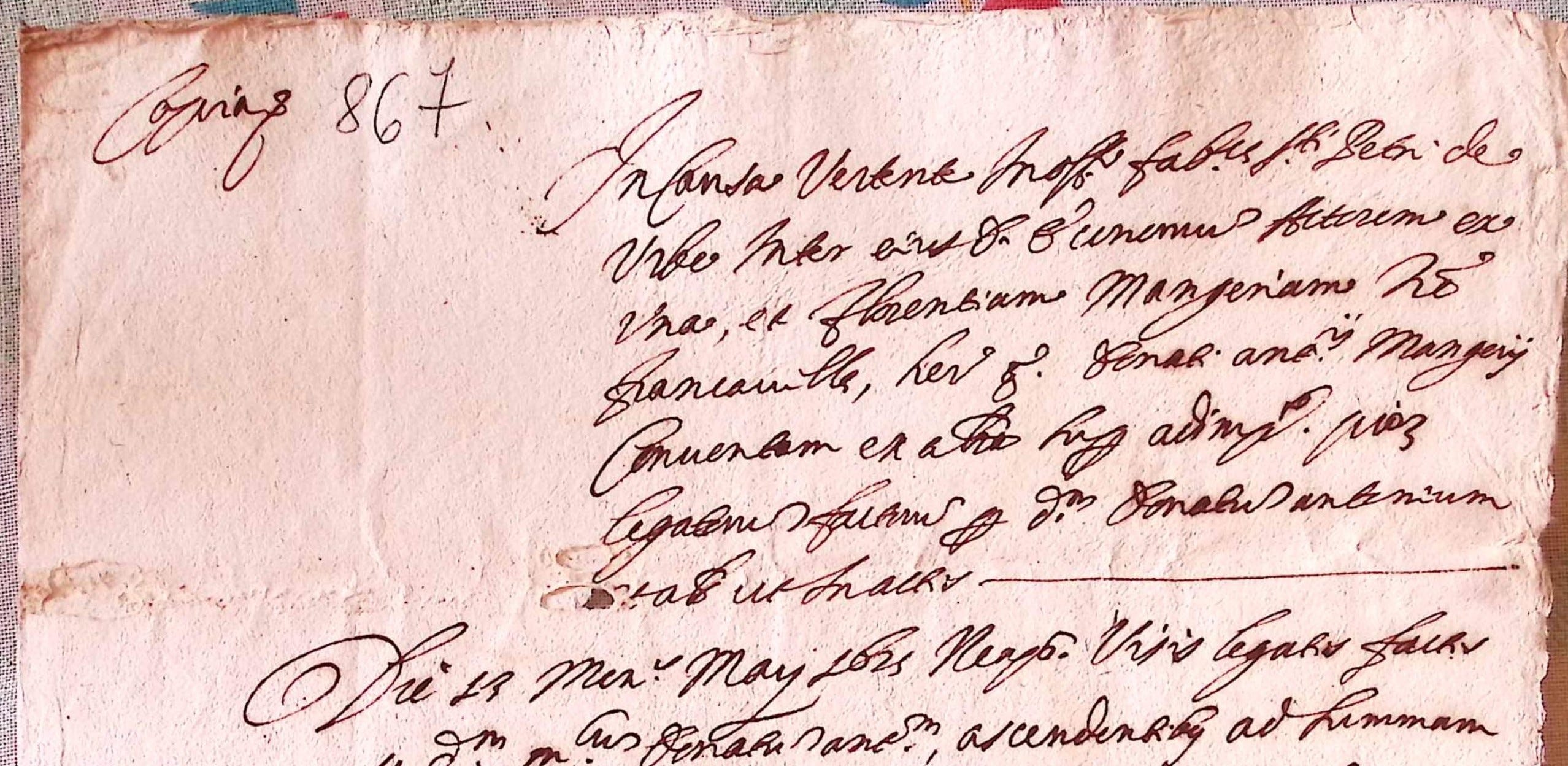
The word ‘copias’ can be seen on the top left of this document. It’s from March 13,1625 in Naples: copy of court proceedings between Fiorenza Mangerio, wife of Giovan Donato Argentina, and her brother Donato Mangerio. The number 867 was written on the document by my uncle as he catalogued the collection. Yeah…I know…still, without his work it would just be trunks full of papers.
I began to imagine the environment in which these papers were written. How did the writing happen? Since many from these early decades of the 1600s are documents regarding legal matters produced by a notary or one of his scribes, I tried to enter that world and observe the work of a notary in his office in Francavilla at that time, and for that purpose it is useful to clarify the role of a notary in the judicial and administrative life of the Kingdom of Naples and its cities and towns.
For this conversation I enlisted the help of someone who practices that role today, in many ways unchanged from how it has been performed for multiple centuries. My cousin Roberto, an esteemed notaio in Salento, was gracious enough to spend some time to help me understand the role of the notary in civil society back in the 1600s; should there be any mistakes in the following description, they are entirely due to misunderstandings on my part.
The notary is the custodian of the documents of record for the judicial memory of the State. At the time when the documents were written, the official versions of these ‘acts’ were the property of the notary who kept an archive of documents he certified. This archive could be passed on to his heirs whether they were in the profession or not. The notary and his successors maintained the archives on behalf of the State and were paid fees by those who required copies for personal records or legal matters they might be involved in. It appears the Argentina family was no stranger to the need of copies of documents relevant to legal litigation. This practice continued until the advent of the Napoleonic administration, which revamped the operations of the State, and among many changes also stipulated that at the end of his career the notary will surrender his archive to the State for its record keeping. This system is still valid to this day not only in Italy but also in many European countries, and some of their former colonies', that have followed the tradition of Latin Jurisdiction since the early days of the Holy Roman Empire. In countries with the tradition of Anglo Saxon Common Law the scope of the notary is much more limited.
Another important function of the notary is one of public faith. Declarations made by an individual in front of a notary are considered self-evident and can be introduced in a legal case or court of law without further certification. Many of the documents I am reading have some version of the phrase: “…appeared in front of me and declared the following in his own words…”; these were legally binding statements certified by the notary who affixed his stamp on the document. At some point in the past few centuries a new role has been added to the scope of a notary’s work: his office was also tasked to collect fees for the State relevant to the business being conducted, such as inheritances, property exchanges, and such things.
But let’s return to the place and time when these documents were created. A notary in Francavilla would have his office on the first floor of his large home, an edifice built sturdily with local stone, and a clear manifestation of his family’s elevated social status in town. Entering the office, we would see shelves full of folders and parchments comprising the official documents in the notary’s archive. There would be the main desk where the notary worked with all the small compartments for his quills and ink jars, wax for sealing and a candle for melting the wax, seals, rulers, and some lockable drawers for sensitive documents and maybe some cash. In front of the desk, scrivania, there are a couple of chairs for his clients to sit. There might be some sunlight from small windows, but it would be supplemented by light produced by candles and olive oil lamps, a terrifying thought in a place designed to store collections of paper. There might be one or more desks, more modest, occupied by scribes working for the notary who sometimes also were apprentices to the profession. Unless the notary was talking to a client or dictating a document, the only sound would be the scratching of quills making their mark on paper or parchment, quills made from bird feathers, most typically duck, turkey, or swan. The points were hardened with fire and then sharpened as needed to keep a fine point using a pen knife, which could also be used to scratch out errors on the writing surface. Unlike the smooth working of current writing implements, quills required a defter tactile sensibility than we have today to produce smooth calligraphy, as their points could get caught in the paper’s fibers causing ink to splatter, or at least producing an unappealing mark. If we stopped for a moment to adjust our eyes to the dim lighting, we could observe the scribes at work. Quills would be dipped in ink wells, and each dip would only carry enough ink for a handful of words before requiring more. By looking carefully at the documents, we are often able to notice the new word after a refill, and the gradual fading of the ink until a new dip in the well is necessary. The best writers created smooth lines of writing where dips in new ink are not so obvious, while others less skilled, or in a hurry, would produce thicker letters after a dip in the ink well. Sometimes a drop of ink fell while the quill traveled from the well to the paper, an error that might anger the notary who might require a new paper, maybe at the scribe’s cost, but if the copy was not important enough, it would be left there. It was also possible to scratch mistakes with the pen knife after the ink dried. The ink, kept in small jars made of glass, ceramic, stone, or metal, was derived from ‘oak galls’, scars or deformities in the trunk or branches of a tree caused by it being used to house eggs of insects. The fluid extracted from those areas would be combined with ferrous sulfate to set a dark color, though with time some of these inks faded into a sepia tint. The liquid was fixed with ‘gum arabic’ extracted from acacia trees to help it attach to the parchment or paper. After laying the ink on the surface, the writer dried it with a powder of finely ground chalk or sand, marking the words permanently. At this time there were two types of writing surfaces on which he could be writing. Paper made from linen or hemp purchased from shops in Amalfi, near Naples, where it had been traditionally made, was used for less important documents or writings that were not intended for official record keeping. Parchment was used for official acts or documents intended for permanent storage, and it was made from treated sheep and goat skin and more expensive.
There are three stages of a document that a scribe might be working on. The first would be the notes taken under the dictation from the notary while he was thinking through a case or taking testimony from clients in his office. These versions may have numerous abbreviations and written in calligraphy not intended for anyone else but the scribe and the notary, who would then check those notes for accuracy before tasking the scribe with writing the official document on parchment, or doing so himself. To authenticate the document, the notary or his assistant would write the formalities required by the judicial authorities, and apply his individual stamp made in metal or stone over melted wax poured on the document. He would also have an identifying complex signature that he would put at the end of a document to signify his certification regardless of whether it was written by an assistant or by the notary himself.


Some of the individual signatures notaries affixed to certify their copies.
After the official document on parchment was completed, the scribe would prepare paper copies for the clients willing to pay for them, on paper often supplied by the clients themselves. These were marked by the word ‘copia’ on the top left corner of the paper which is the case for a majority of the documents in the Argentina collection that have a legal purpose. If the content required to be written on multiple pages, they were sometimes sewn in booklets, and indeed, some of the documents I am reading are bound with careful stitching that is still functional four centuries later.
Besides the writing surfaces, paper or parchment, sharp scissors or blades to cut them, ink jars, drying powder, the quills and pen knives, rags for cleaning hands and surfaces, the few other objects that might be found on the desks of the scribes might be straight rulers if there were listings or accounting notes to make, and maybe a compass if necessary to make indicative arcs. A busy notary may have employed multiple clerks, all working under his watchful eye as he dictated to one of them while also moving around to check the quality of the work of the other ones. One can imagine that a scribe working on their second or third copy, stressed by the boss demanding speed in execution would maybe rush through them. Maybe they didn’t like that particular client, or their boss, or they were grumpy that day, or maybe they were new apprentices and just not that good. It could also be that what I consider poor cursive calligraphy today was not considered so bad half a millennium earlier.
Thank you for indulging me in this reflection on the making of the documents we will consider for the next essay. We will work to create a plausible story from the early decades of the 1600s about Fiorenza Mangerio and her family before and after she married Giovandonato Argentina.
Nice chapter … and thanks for the mention, Roberto